
The Spirit of Same Sex Love
In his 2024 book Sacred Flames: Reclaiming the Divine Power of Gay Love, American author Pete Cossaboon directs a heartfelt plea to Queers of the world to claim our spiritual inheritance as shamans, mystics, healers, witches, monks, goddess priests and priestesses – connectors to the cosmic reality.
“In today's world, where LGBTQ+ people still face discrimination, homophobia, and exclusion, reclaiming this sacred heritage is an act of defiance and liberation. It allows us to rewrite the narrative of what it means to be spiritual and queer, rejecting the harmful rhetoric of religious institutions that continue to marginalize us. It is a call to embrace our full selves-our love, our desires, our bodies-as holy.”
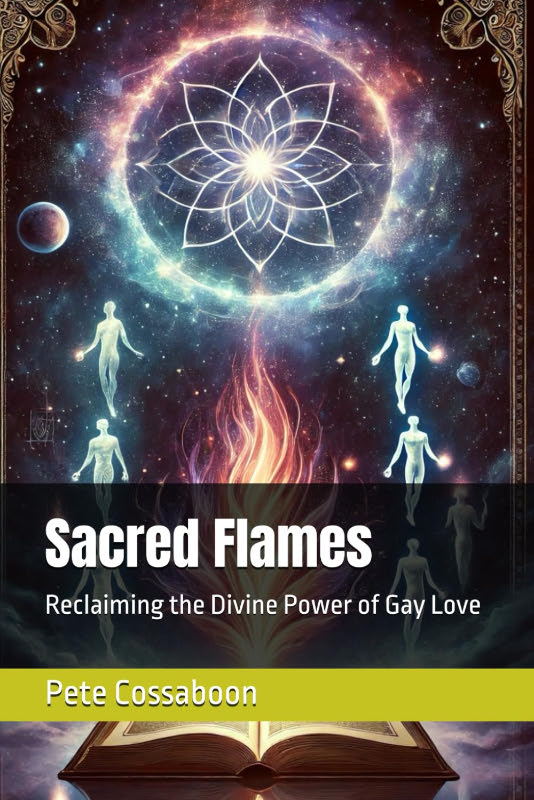
Pete's book is a direct call to gay men, whose spirituality has been crushed and denied by religious attitudes for centuries. But the basic message applies to lesbians and trans people just as much, he simply was speaking to the community he knows best.
“Reclaiming the spiritual dimensions of same-sex love is not just an academic exercise, it is a vital act of healing and empowerment for gay men today. Understanding that our love is sacred, that it has always been sacred, transforms how we see ourselves and our place in the universe.
"For centuries, gay men have been told that their love is incompatible with spiritual growth. Many have been driven away from organized religion or left to reconcile their spirituality in isolation. But the truth is that same-sex love is not only compatible with spirituality-it can be a powerful source of divine connection and personal transformation. When we reclaim the knowledge that has been hidden from us, we begin to heal from centuries of religious trauma and cultural erasure.
“This reclamation is a necessary step toward redefining queer identity in spiritual terms. The disconnection that many gay men feel from traditional spiritual practices can be replaced with a sense of belonging and purpose. We are not excluded from the divine; we embody it. By integrating spiritual practices that honor same-sex love-whether through meditation, ritual, or community-building-we can create new pathways to enlightenment that affirm our identities...
“Moreover, by reconnecting with our spiritual heritage, we tap into the wisdom of our queer ancestors-those who lived, loved, and found divinity in their relationships long before us. We honor their struggles and sacrifices while paving the way for future generations to experience their love as a sacred force.
“This knowledge matters because it reaffirms that we, as gay men, have a unique role to play in the spiritual evolution of humanity. Our love is not a deviation from the divine plan; it is a crucial part of it. As we reclaim our spiritual inheritance, we contribute to a broader, more inclusive understanding of spirituality-one that celebrates diversity, honors love in all its forms, and recognizes the inherent divinity within every individual.”
The AIDS years brought a time of deep soul-searching for some gay men, which led to a surge in books about gay male spirituality in the 1990s and early 2000s. Pete Cossaboon's book follows in the footsteps of works such as:
- Mark Thompson – Gay Soul: Finding the Heart of Gay Spirit and Nature
- Toby Johnson – Gay Spirituality; Gay Perspective
- Christian de la Huerta – Coming Out Spiritually: The Next Step
- Andrew Ramer – Two Flutes Playing: A spiritual journeybook for gay men
- Randy P Connor – Blossom of Bone; Encyclopedia of Queer Myth, Symbol and Spirit
- Andrew Harvey – Gay Mystics
- John R Stow – Gay Spirit Warrior
- Queer Dharma: Voices of Gay Buddhists
- Christopher Penczak – Gay Witchcraft
- Michael Thomas Ford – The Path of the Green Man
Lesbian spirituality has been less written about!
But lesbian and bisexual women have been very prominent in the spiritual reclaiming side of late 20th century feminism. Activists such as Starhawk and Zsuzsanna Budapest back in the 70s were calling for a revolution in consciousness – an awakening to the Goddess consciousness within us all, to a 'feminine' mindset that views and knows – because it feels the truth that – all life is an interconnected unity. What we do to one affects us all. What we do to others, to the earth, we do to ourselves.
Zsuzsanna Budapest understood and advised back in the early 80s that: “By accepting all elements in nature, we make whole the collective and individual Soul.”
Starhawk: “Too often we have seen the movement for trans and nonbinary rights as separate from the movement for women’s rights that arose from the second wave of feminism. That division only serves to reinforce the structures of authoritarian male rule. Our issues are not separate, and our interests are far more common than they are divided.”
Perhaps one of the most powerful descriptions of the spiritual energy of sexual love between women was written by English poet Elsa Gidlow (1898-1986).
“Woman, so gentle in my arms
Loving, you have opened to me
Fierce, my own dark heart
And found therein and to me reflected
My source of light…..
Here on this bed, holding you
So human in your need (and knowing mine)
Miraculous, the human veil is rent.
Lover-beloved, Woman
Small and strong in my arms
I know in you
The Goddesss, Mystery, fecund Emptiness
From which all fullness comes
And universes flower.”
Born in Hull, Yorkshire, Elsa went on to live in Canada and the USA. Her writing circle in 1918 created the first gay magazine in North America…Les Mouches Fantastiques. From 1954 she lived in California. naming her ranch Druid Heights. Among her companions there was philosopher Alan Watts, with whom she found the Society for Comparative Philosophy, and her friends included Maya Angelou, James Broughton, Allen Ginsberg, Neil Young and Ram Dass. She wrote poetry for 70 years, drawing on her own ecstatic experience of sexual passion with her lesbian lovers, and was a pioneer of sexual-spiritual freedom.
To be queer is to naturally question the way society works. It is up to each of us how far we take this. American writer Caffyn Jesse says in Orientations: Mapping Queer Meanings (2015), of the common experience that lesbians, trans people and gay men all have in our cis-hetero-dominated, conformist, world - “Alienation and marginalization are not just difficulties to overcome. They are great adventures. They are instruments of analysis. We learn to scrutinize and contest boundaries, to mine them for pleasures and open them to possibilities. Homosexuality opens up the space between self and other, male and female, us and them. Queer leads to deep resources and dangerous meanings.”
The noble spirit of same sex love and that of transgender people, has been denigrated for so long by religion, made illegal by politicians, analysed and pathologised by psychiatry and science, that queer people today have very little notion of the true history of gay men, lesbians, bisexuals and trans people – of just how widespread and normal bi + homosexuality and gender variant expression has often been, nor the special holy roles that people like us were once associated with. Modern queers tend to look only to the 20th century for our history – but that is the century that gave birth to a gay liberation movement that tried to reassure the dominant hetero culture that we pose no threat, that claimed we are no different to them except for whom we love.
This view of us as minority simply locks us into being a sub-class, assimilated into the whole, adopting their goals and ceremonies. However, an essentialist view of our nature proposes that we have our own ways of being and our own destiny, that the sexual and gender subcultures bring something unique, powerful and necessary to the human whole: especially those gifts of vision, love and spirit that have been denied and repressed for so long – such long centuries in fact that we often have to some deep digging within before we even see them within ourselves.