Dwellers at the Threshold: Queer Lives Cast in Bronze, by Brenden “Tiger” Shucart
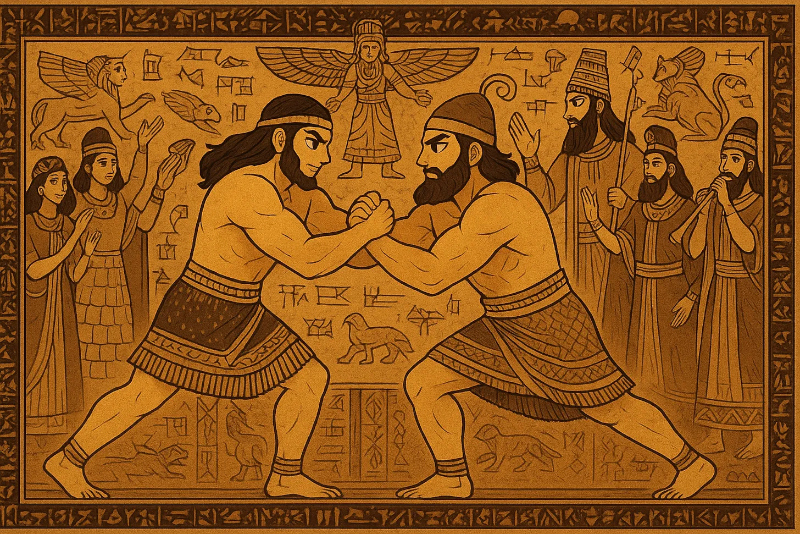
We moderns have a tendency to think of the “ancient world” as a single block of time, like Julius Caesar and King Tut were drinking buddies. But fun fact: history is big. Really big. How big? Less time separates us from Julius Caesar than separated him from the builders of the pyramids. And Ancient Mesopotamia—the “land between the rivers,” cradle of civilization—was already old when the Egyptians built the pyramids. (Unless you’re a Graham Hancock truther, but I digress.) For nearly three thousand years, Mesopotamian civilization was the beating heart of the world, and it left us something remarkable: real, tangible evidence that queer lives were not only present, but honored, feared, and woven into the very fabric of the cosmos.
It’s worth lingering here a moment. Because while we’re in the present, arguing over drag queen story hour, back in Mesopotamia—the civilization whose bones our civilization is built on—scribes were writing hymns about non-binary priests, warriors who wore both armor and women’s dress, and kings who kissed their male lovers like brides.
Between the Rivers, Between the Worlds
Mesopotamia was born out of disaster. When the Ice Age ended, the fertile swamps of southern Iraq shrank into dust. To survive, people turned to the rivers—Tigris and Euphrates—whose violence demanded control. Floods had to be tamed with canals, dikes, and dams. That meant organizing labor, building bureaucracy, creating law. Civilization, in other words, was forced into being.
And just as the Mesopotamians learned to navigate the in-between of flood and drought, they created space for people who lived between categories of sex and gender. Their cosmology split the world into heaven and earth, but always left room for the threshold—twilight, tombs, and crossroads—those liminal spaces where the gods crossed into mortal affairs. That liminality became a sacred domain for queer people.
The First Third Gender
Sumerian creation myths describe the goddess Ninmah shaping a being with neither penis nor vagina. Enki, god of wisdom, looks at this strange creature and decrees: you will stand before the king, a person of privilege. A third gender, made not by accident but on purpose. From the beginning, queerness was written into the divine blueprint.
And so we meet the assinnu, the kurgarrû, the kalû - priests and ritual specialists who didn’t conform to male or female roles but served served Inanna/Ishtar - goddess of paradox and contradiction.
The assinnu were known as “man-women,” healers who brought people back from the brink of illness. Because they straddled the line between genders, they were believed to straddle the line between life and death. Some served as prophets, their words believed to slip more easily between worlds.
The kurgarrû lived closer to chaos. They dressed like warriors yet were listed among the women musicians. Their rites were deliberately transgressive, stirring divine fury and then resolving it—a ritual of crossing and returning. Contradictions made flesh, their power in the dissonance.
The kalû were mourners, chanters of laments. The job of lamentation once belonged to women alone, performed in a special high-pitched dialect of Sumerian called Emesal, “the women’s tongue.” But over time, the role shifted to these non-binary chanters. Their wails soothed the heart of the goddess, their voices proof that gender was not destiny but calling.
You can read all this in cuneiform, pressed into clay tablets four thousand years ago. They tell us plainly: gender-nonconforming people were not just present—they were indispensable. They sang at funerals, healed the sick, advised kings, soothed goddesses, and carried prayers across forbidden boundaries. They lived what Inanna embodied: the refusal of neat categories.