From Pride To Power, by Shokti
LGBTQ+ Pride was created to be the antidote to the SHAME that was forced onto queer people for centuries, and is as important today as it's ever been for that shame has deep roots.
The Catholic Church long ago declared same sex relations a sin (one its priests, monks and even popes often succumbed to!)– and eradicated heretical groups who did not agree (so associated was queerness and heresy that the word buggery, derived from the Bogomil heretics who originated in Bulgaria, originally was a term for a heretic). Reformation Protestant Martin Luther believed that same sex desire comes, “undoubtedly from Satan, who, after people have once turned away from the fear of God, so powerfully suppresses nature that he beats out natural desire and stirs up a desire that is contrary to nature.” (One of his issues with the Papacy is recorded in his claim that Pope Leo X had vetoed a measure that cardinals should restrict the number of boys they kept for their pleasure, "otherwise it would have been spread throughout the world how openly and shamelessly the pope and the cardinals in Rome practice sodomy").
Sodomy came to be regarded in the western world as the greatest sin that could be committed.
On top of that, secular laws against same sex relations were enacted from the late Middle Ages – Henry VIII's Buggery Act of 1533 was part of his seizure of powers from the ecclesiastical courts, which had handled accusations of sodomy until that time. Henry used the law as a justification to close down the Catholic monasteries – in 1535 agents were sent to visit the monastics and report on sexual misconduct taking place. The many reports of sexual, especially same-sexual, activities was used by Henry as justification to dissolve the monasteries, and seise their wealth to fill up his empty royal treasury. Robert Burton wrote in ‘Anatomy of Melancholy’ in 1621 that “... the most prudent Henry VIII… inspected the cloisters… of priests and votaries, and found among them so great a number of wenchers, gelded youths, debauchees, catamites, boy-things, pederasts, sodomites, Ganymedes etc, that in everyone of them you may be certain of a new Gomorrah.”
Henry VIII brought in the death penalty for anal sex, a law that would have its most devastating impact in the 18th and 19th centuries, the last hanging occurring in 1835 and the death penalty only repealed in 1861.
The repeal of the death penalty did not end persecution – tough penalties could still be imposed (as Oscar Wilde would learn), and the 1885 Criminal Law Amendment Act introduced the crime of 'gross indecency between males', which would haunt the lives of gay men in Britain for the century ahead, with prosecutions actually increasing after the partial decriminalisation of sex between men in 1967 (sex had to be in private between 2 men only, aged over 21).
In the late 19th century the new profession of psychology added to the pot of shame poured onto queer people. Homosexuality became the new word on the block and was considered to be a malign condition, a mental illness – only being declassified as a mental disorder in 1973.
Then in the 1980s – AIDS – more shame, more fear:
But also a fightback like never before.
Building on the pioneering work of Gay Liberationists in the 1970s suddenly Pride events expanded and multiplied. LGBT people were on the streets claiming our right to be ourselves as never before. We founded institutions such as Stonewall, and gained wide social acceptance, followed by an equal age of consent finally arriving in UK, plus civil partnerships and gay marriage spreading through much of the western world in the 2000-10s.
Then came QUEER. For many of us Queer is a great umbrella term for the whole community – I love the word because of it's German roots: quer implies crossing over, going the alternative way to, the mainstream flow. We are queer because we do not fit the model of heteronormative social expectations, relating to how we have sex, how we express gender, whom we love. Those in the community who object to the use of Queer because of its history as a slur have no sense of the power of reclaiming! Gay itself became for some a term of abuse in the 90s, but we didn't drop the word we fought back. I am also part of the global Radical Faerie tribe – Faerie was chosen very consciously to find power in a word that had been used to attack us. The first Queer activists in the late 80s and early 90s were doing the same thing. But those who dislike queer start to claim that Q is an identity of its own – and it can be for those who do not feel they fit into the boxes of lesbian, gay or trans – but it is also a powerful term for us all, reminding us we are here to be ourselves and support all people to find their inner freedom! Queer breaks down the barriers between us, and has the capacity for those with heterosexual leanings who also do not fit into the socialised norms and expectations to share space, share purpose, show solidarity, with us.
Trans people have always been part of this gay-queer liberation journey. The borders between L,G,B and T are not fixed, they are very fluid. Many cultures around the world recognise a 'third gender' – those who are not embody both masculinity and femininity in their personhood. Third gender people have historically often been considered to have a spiritual calling, in cultures around the world, including that of ancient Europe where the feminine men served in the Goddess temples with the women.
AS WE MARCH WITH PRIDE THIS YEAR
let's remember we are still shaking off centuries of SHAME
imposed onto our kind by religion, lawmakers and psychology.
Releasing, refusing that shame we open the gates to reclaiming the power in us that shame kept suppressed: the power to love, to create beauty, to be bridges between communities, to walk between worlds, to be healers of the soul and channels of spirit, to be midwives to the dying, and participants in the birth of a more enlightened, conscious, compassionate age of planet Earth.
The LGBTQ+ community is a global network. Whether we identify as spiritual or not we are people reaching for a more equitable, peaceful, playful world! That is in our nature. And some of us are called to explore the magical depths and heights of that nature. Gay men have always been drawn to serve in religious communities, even those who condemn us. Religion has less influence in our lives now, but the spiritual call remains – channelled by many into the realms of sex and drugs, where we get a taste of the bliss our souls crave. But consider this point made in Andrew Ramer's spiritual journeybook for gay men 'Two Flutes Playing' that “All of our addictions, to chemicals and to behaviours, mask our ancient shaman powers.”
Before there were temples and churches there were shamans. Shamanism is having a massive global revival today but few shamanic teachers mention the fact that historically, the most powerful shamans were often queer.
In his book The Origin and Development of Moral Ideas, Finnish philosopher Edward Westermarck (1862-1939), published 1906, writing about Siberian tribes, recorded that:
“The change of sex was usually accompanied by future shamanship; indeed nearly all shamans were former delinquents of their sex. Among the Chukchi male shamans who are clothed in woman’s attire and are believed to be transformed physically into woman are still quite common; and traces of the change of a shaman’s sex into that of a woman may be found among many other Siberian tribes…”
He also noted: “In America, homosexual customs have been observed among a great number of native tribes. In nearly every part of the continent there seem to have been, since ancient times, men dressing themselves in the clothes and performing the functions of women, and living with other men as their concubines or wives…”
Echoing the words of many early European explorers in the New World, Westermarck wrote that:
“There is no indication that the North American aborigines attached any opprobrium to men who had intercourse with those members of their own sex who had assumed the dress and habits of women. In Kadiak such a companion was on the contrary regarded as a great acquisition; and the effeminate men themselves, far from being despised, were held in repute by the people, most of them being wizards…”
Queerness is not a biological phenomenon!
For years they tried to find a gay gene
Now it is argued that our chromosomes create and define our gender.
The future will laugh at such ignorance.
We are people of Spirit. All possibilities exist in us.
We are bridges between the men and the women, between the earth and the stars.
Queer Spirit calls us home to our power.
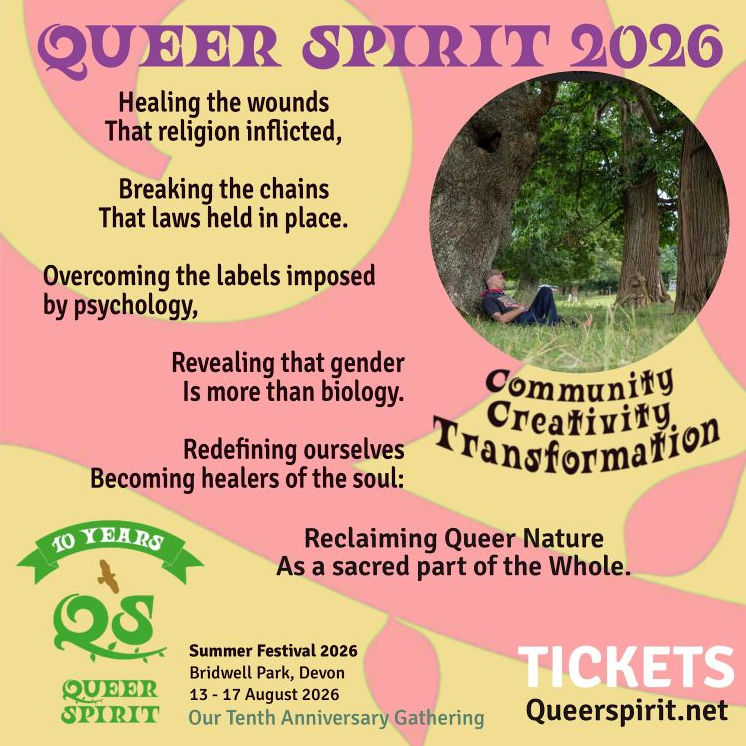
Hope To See You In Bridwell Park This August To Reclaim, Raise And Celebrate The Queer Spirit!